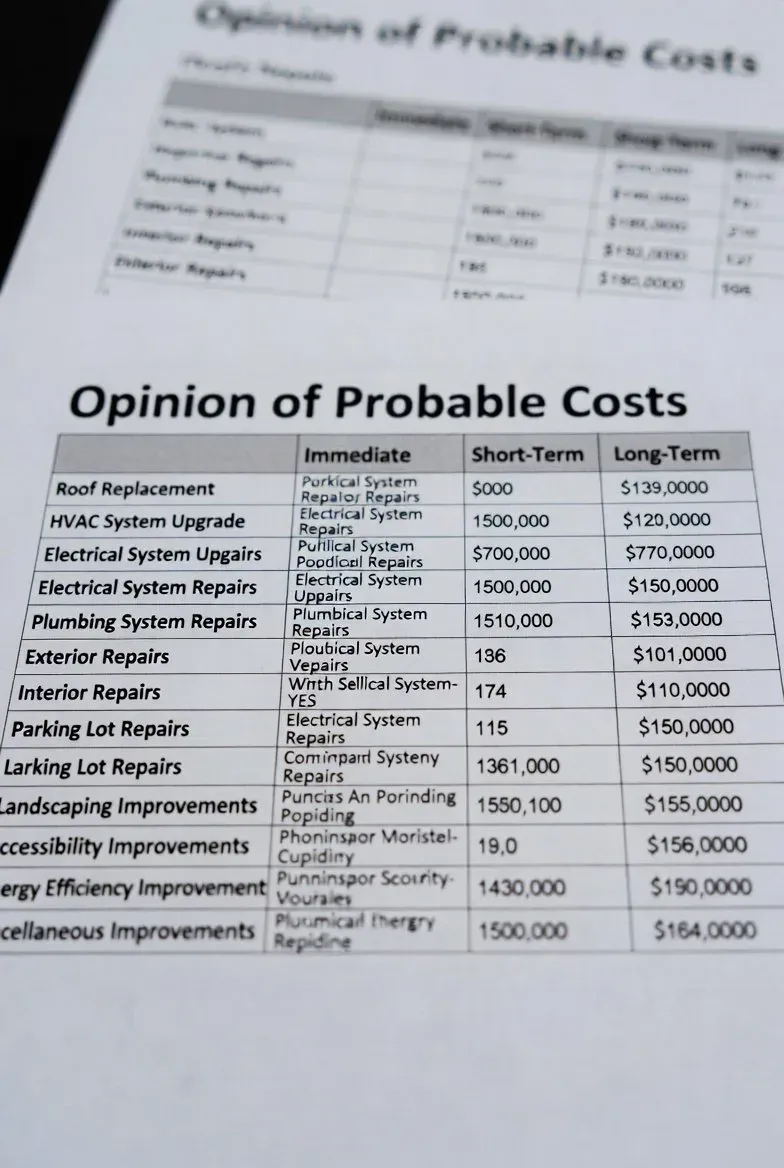
In a property condition report, immediate repairs are items that need action now or in the short term. Replacement reserves are the planned costs of replacing building components over a longer period. Freddie Mac projects reserves for the loan term plus two years, up to 12 years. Lenders turn both tables into escrows or reserve deposits.
What are immediate repairs in a PCA?
Immediate repairs are the items the consultant says should not wait. They usually include safety problems, failing systems and overdue maintenance.
The two agency lenders define the term in their own guides. Fannie Mae’s Multifamily Guide says needs identified as Immediate Repairs in the PCA include life safety repairs, critical repairs, deferred maintenance, and short-term replacement of capital items. Freddie Mac uses different labels: Critical Repairs, Priority Repairs, and PR-90 Repairs.
Our PCA versus CBI guide describes the immediate repairs table as the part of a PCA that lists items requiring near-term action, with an opinion of probable cost for each.
What are replacement reserves?
Replacement reserves look ahead. They are the planned cost of replacing components as they reach the end of their useful life, such as roofs, paving, boilers and rooftop units.
Our PCA versus CBI guide says a PCA typically includes a 10 to 12 year Replacement Reserves Table built from remaining useful life estimates for each major system. A CBI does not require one.
Fannie Mae defines a Replacement Reserve as a custodial account the borrower funds during the loan term for replacements. Freddie Mac’s guide says the property condition consultant must identify capital needs over the loan term and establish the appropriate amount of Replacement Reserves. Freddie Mac then reviews the consultant’s assessment and determines the actual reserve amount.
That last point matters. The consultant proposes. The lender decides.
How do the two tables differ?
| Immediate repairs | Replacement reserves | |
|---|---|---|
| Question answered | What needs fixing now? | What will need replacing later? |
| Time frame | Now, or within a deadline set by the lender | The loan term or hold period |
| Typical contents | Safety items, failing systems, overdue maintenance | Roofs, paving, mechanical equipment and other components with a finite life |
| Money mechanism | Repair escrow or a deadline to complete the work | Reserve account funded over time |
How do lenders use each table?
Fannie Mae
Fannie Mae’s guide sets completion deadlines for repairs found in the PCA:
- Life safety repairs on an acquisition must be completed within 60 days after the loan origination date.
- Critical repairs must be completed within 6 months after origination, or sooner if the consultant recommends.
- Deferred maintenance or items of note must be completed within 12 months, or sooner if the consultant recommends.
- Short-term replacements are due by the date the consultant recommends, which may be longer than 12 months.
The guide also gives a funding guideline. The completion/repair escrow funded at origination should be at least 125% of the estimated cost of the required repairs. A lender can choose not to fund it entirely if the borrower has the financial capacity to complete the work, but must then get written assurances that the repairs will be done in a stated time.
Freddie Mac
Freddie Mac’s guide separates repairs this way:
- Critical Repairs must be corrected before Freddie Mac will proceed with the transaction.
- Priority Repairs must be addressed within 365 days after origination. They include all life safety hazards and violations of laws and codes.
- PR-90 Repairs are Priority Repairs that must be addressed within 90 days. They cover life safety hazards that pose an imminent risk to tenants, and conditions that may cause imminent damage to a major building system.
- Deferred maintenance with a cost of more than $3,000 per repair item falls in the Priority Repair group. Items at $3,000 or less are treated as routine repairs and maintenance.
For the reserve table, Freddie Mac’s guide says the assessment projects the need for replacements and repairs for the mortgage term plus two years, up to a maximum of 12 years.
HUD
HUD’s RAD notice refers to a “CNA 20-year replacement schedule” as the basis for sizing a replacement reserve on those projects. HUD calls its report a Capital Needs Assessment (CNA), and 20 years is longer than the 12-year cap in Freddie Mac’s guide. See our capital needs assessment service for that product.
How is a reserve table different from cost to cure?
Reserves and cost to cure use similar numbers for different jobs.
A replacement reserve table plans for components that will wear out over the hold period. A cost-to-cure report is a structured inventory of deficiencies with an estimated cost to fix each one. Calibre’s cost-to-cure reports sort items into Immediate (safety or functional failure), Short-Term (1 to 3 years) and Deferred (3 to 10 years), then total each group.
In practice, a buyer uses cost to cure to negotiate price or ask for credits at closing. A lender uses reserves to protect the loan after closing. Our guide to cost-to-cure tables and opinions of probable costs explains the buyer’s side in more detail.
How should you read the tables?
Ask five questions of any PCA you receive:
- What system does each line item cover, and where on the property is it?
- Is the item a repair or a replacement? Repairs belong in the immediate table. Replacements belong in the reserve table unless they cannot wait.
- Does the item meet a lender’s category, such as Critical or Priority?
- What remaining useful life did the consultant assume, and why?
- Does the reserve horizon match the loan term plus any lender add-on?
Also keep in mind what the standard says about the report. ASTM E2018-24 says the assessment is not intended to be technically exhaustive, and that suggested remedies are often formed without engineering calculations or testing. Cost opinions are opinions. Freddie Mac, for one, sets the final reserve amount itself. Our article on why a bigger PCA budget does not buy a better report covers what extra scope can and cannot add.
Next step
If a lender has sent you a PCA requirement, tell us the loan program and the closing date. We can match the immediate repair categories and the reserve horizon to the lender’s guide. Start with our ASTM property condition assessment page. Both agency guides are revised over time, so confirm the current text with your lender before you rely on a deadline.
Sources
- Fannie Mae Multifamily Guide, Section 405, Completion/Repairs
- Fannie Mae Multifamily Guide, New Property Condition Assessments
- Freddie Mac Multifamily Guide, Chapter 62, Property condition
- HUD, RAD Notice Revision 4 (H-2019-09, PIH-2019-23)
- ASTM E2018-24, Standard Guide for Property Condition Assessments