

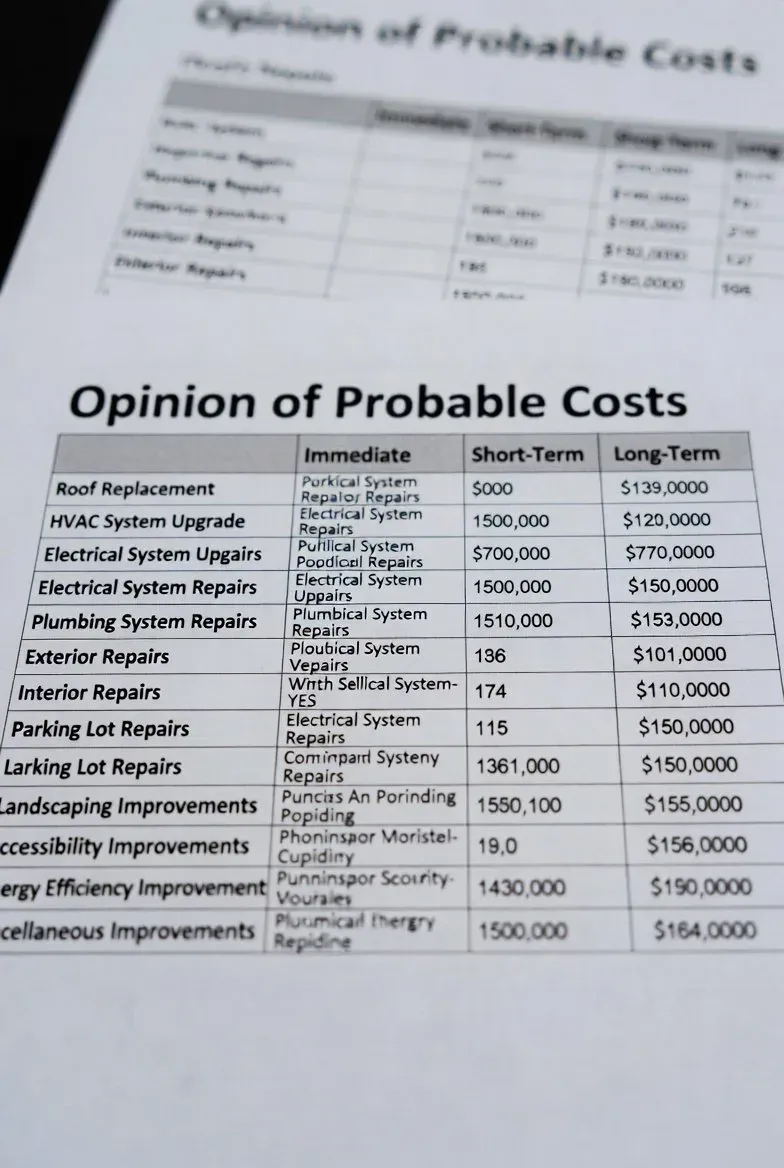
A property condition report can run to many pages. The buyer needs a few numbers and a few decisions. This guide shows where to look first, what each table means, and what the numbers can and cannot support.
The report may be a Property Condition Report under ASTM E2018, a narrative commercial building inspection with cost opinions, or a Cost-to-Cure Report. The tables differ in name and layout. The questions are the same.
Read in this order
- The summary. Look for the total of immediate costs and the total of reserves. Note the dates and the scope.
- Scope and limits. Find out what the inspector saw, what the inspector did not see, and what the report excludes.
- The immediate repairs table. These are the items needing action now.
- The system sections. Check each system’s condition, age, and expected life.
- The reserve table. See what must be replaced and when.
- Photos and appendices. Confirm that the photos match the findings.
The parts of a report
| Part | What it tells you | What to check |
|---|---|---|
| Summary | Overall condition, key issues, totals | Do the totals match the tables? |
| Scope and limitations | What was and was not done | Were any areas not accessible? Which specialists were not used? |
| System findings | Condition of site, structure, roof, envelope, mechanical, electrical, plumbing, life safety, elevators, interiors | Age, condition rating, remaining life |
| Immediate repairs | Deficiencies needing prompt action, with costs | Safety, code, and imminent failure items first |
| Reserve (long-term) table | Replacements over the forecast term | Term length, inflation assumptions, unit costs |
| Exclusions | Costs not included | Permits, design fees, escalation, hidden conditions |
| Photos | Evidence | Locations and dates |
Cost-to-cure and opinion of probable cost: two terms, one purpose
Calibre’s guidance separates the terms this way.
A cost-to-cure table is the inventory. It lists the deficiencies, their locations, a priority, and an estimated cost for each. It is grouped by system.
An opinion of probable cost is the professional estimate behind each cost. It comes from the inspector’s experience, regional cost knowledge, and industry standards. It is not a contractor’s bid. It often appears as a range. It states its exclusions.
Many reports contain both in one document. See Calibre’s cost-to-cure service, its article on cost-to-cure tables and opinions of probable costs, and its article on how a defensible repair cost estimate gets built.
Immediate vs short-term vs long-term
Terms for urgency differ by report and by lender. Match the report to the rule that applies to you.
| Source | Terms it uses |
|---|---|
| ASTM E2018-24 (per Calibre’s article) | Immediate costs: deficiencies needing prompt action, including life-safety conditions, imminent system failures and code violations |
| Fannie Mae Multifamily Guide | Life safety repairs, critical repairs, deferred maintenance, short-term replacement of capital items |
| Freddie Mac Multifamily Guide | Critical Repairs and Priority Repairs |
| HUD MAP Guide | Critical life safety repairs, critical accessibility repairs, non-critical repairs |
If a lender is involved, ask how it treats each category. Fannie Mae, for example, requires life safety repairs within 60 days after an acquisition loan originates, critical repairs within six months, and deferred maintenance within 12 months. See what lenders require.
The reserve table
The reserve table (also called a replacement reserve table or capital reserve schedule) projects when major components will need replacement. It rests on each component’s age, its expected life, and its remaining useful life.
Check these points:
- The term. How many years does the table cover? Lender rules may set the term. Fannie Mae’s rule, for example, runs to the sooner of two years after maturity or 12 years after origination. Freddie Mac’s runs the loan term plus two years, up to 12 years. HUD and USDA use 20 years. Calibre’s PCA vs CBI article describes a typical PCA reserve table of 10 to 12 years. The ASTM standard itself leaves the term to the agreed scope.
- The unit costs. Where did they come from? Local cost data is best.
- The inflation factor. Calibre’s article on ASTM E2018-24 notes that any inflation factor in a long-term cost opinion is a constant rate, not an economic forecast.
- What is missing. Items the report only notes, such as generators, building automation, EV charging, and tenant-owned equipment, may carry no cost.
Calibre’s article explains that the long-term cost opinion in E2018-24 is an optional extension, not part of the baseline, and that it excludes design, permitting and professional fees. It also says the standard states that those opinions are not suitable for setting reserves for condominiums and other common interest properties, which carry regulatory and accounting rules. Read A Bigger PCA Budget Will Not Buy You a Better Report.
Because the long-term opinion is an extension, confirm that your report includes it. Do not assume it does.
What the numbers can and cannot do
They can:
- Show the likely scale of near-term spending
- Rank repairs by urgency
- Support a price discussion with specific line items
- Feed a capital budget
- Give lenders a basis for escrows and reserves
They cannot:
- Replace contractor bids
- Predict the cost of hidden conditions found when work begins
- Fix the exact timing of a failure
- Replace specialist analysis where the report calls for one
ASTM’s scope summary for E2018-24 says the standard does not require engineering calculations, testing or invasive probing. It says the report reduces uncertainty but cannot remove it. A cost is only as good as the observation behind it.
Terms you will see
- Deficiency. A condition that falls short of what the system needs to work as intended. The report should describe it and give a location.
- Deferred maintenance. Needed upkeep that was not done. Calibre’s building inspection scope treats deferred maintenance as a core finding.
- Remaining useful life (RUL). The estimated time a system or component can keep working before it needs replacement. Calibre’s article says reserve tables are built from RUL estimates for each major system.
- Life safety item. A condition that may put people at risk. Lenders often set a short deadline for these.
- Opinion of long-term costs. A forecast of major refurbishment and replacement over an agreed term. It is an order-of-magnitude figure, per Calibre’s article on the standard.
- Exclusions. Costs the report does not include, such as permit fees, escalation, or costs of finding more problems during repair.
Same report, different readers
One report serves several readers, and each reads it differently.
- The buyer looks for price leverage and for the cash needed in the first year.
- The lender looks for life safety items, critical repairs, and the reserve it will require. Its rules may override the buyer’s plan.
- The broker looks for a clear, line-by-line case to put in front of the other side.
- The asset manager looks for the reserve table, since it drives the capital budget.
- The seller may use the same data to price correctly or to fix items before the buyer’s inspection.
Calibre’s article on cost-to-cure tables makes the same split: buyers use the numbers to decide whether a purchase fits the budget, brokers use them to negotiate, and lenders use them to understand exposure and set reserves.
Questions to ask the inspector
- What did you not see, and why?
- Which items are most likely to change if a specialist looks?
- Are the cost numbers ranges or points? What is in each range?
- What costs are excluded?
- How did you set the unit costs, and when?
- What does “immediate” mean in this report?
- Which items would you test or core before closing?
- Does the reserve table assume tenants’ equipment? Who owns it?
- What does the report say about code or accessibility items?
- If the lender requires a specific form, does this report meet it?
How to use the report in a negotiation
- Start with specific lines. A line item with a location and a cost range is more persuasive than a general concern.
- Separate repair from replacement. An immediate repair may justify a price credit. A reserve item is part of the normal cost of owning the building. Argue each on its own terms.
- Get bids on big items. For roofs, mechanical plants and paving, send the relevant pages to contractors, and ask them to bid the same scope.
- Mind the lender. The lender may require repairs or reserves based on the report, whether or not the seller agrees.
- Keep the report. It is your baseline for later capital planning.
Common reading mistakes
- Reading only the total. A big total made of many small items is not the same as one big failure.
- Treating reserves as repairs due now.
- Treating the opinion of cost as a quote.
- Ignoring exclusions.
- Comparing two reports with different scopes. Calibre’s article shows that two ASTM-compliant proposals can differ because one added specialist work, a long-term cost opinion, or field counts.
- Using a report from a different standard than your lender needs.
A blank template for your own notes
Use this layout to track the report in your deal. Fill it from the report, not from memory.
| Item | System | Urgency (per report) | Cost range (per report) | Who must act | Needs specialist or bid? |
|---|---|---|---|---|---|
| (from report) |
Calibre builds cost-to-cure reports from commercial building inspections and can scope the cost opinion to your decision. Request a proposal.
Frequently asked questions
What is a cost-to-cure table?
It is an inventory of deficiencies found in a commercial property inspection, organized by system, with the location, priority and estimated cost of each item. It turns findings into a budget view for buyers, brokers and lenders.
What is an opinion of probable cost?
It is a professional estimate of repair or replacement cost, based on the inspector's experience, regional costs and industry standards. It is not a contractor's bid. It is often a range and states what it excludes.
What is the difference between immediate repairs and replacement reserves?
Immediate repairs address deficiencies that need prompt action, such as life-safety conditions, imminent failures, and code violations. Replacement reserves forecast the cost to replace components over a longer period as they reach the end of their lives.
How accurate are the costs in a property condition report?
They are opinions. They depend on what the inspector could observe, the cost data used, and the exclusions. Actual costs vary with contractor, timing, hidden conditions, and permits. Use contractor bids to confirm large items.
How long should the reserve table cover?
It depends on the report and the lender. Fannie Mae's rule runs to the sooner of two years after maturity or 12 years after origination. Freddie Mac's runs the loan term plus two years, up to 12 years. HUD and USDA use 20 years. ASTM leaves the term to the agreed scope.
Can I use the report to ask the seller for a price reduction?
Yes. Specific line items with locations and cost ranges support a credit request. Separate immediate repairs from normal long-term replacement, since they carry different weight in a negotiation.
Does a property condition assessment include a reserve table?
Calibre's comparison of the two products says a PCA typically includes a replacement reserves table and a commercial building inspection does not require one. The long-term cost opinion under ASTM E2018-24 is described as an optional extension, so confirm what your report includes.
Are the numbers in a PCA suitable for setting condominium reserves?
Calibre's article states that E2018-24 says its long-term cost opinions are not suitable for setting reserves for condominiums and other common interest properties. Those reserves carry their own regulatory and accounting rules.
Sources
- ASTM E2018-24, scope summary
- Fannie Mae Multifamily Guide, Part II, Chapter 4 (Sections 404 to 406)
- Freddie Mac Multifamily Seller/Servicer Guide, Chapter 66
- HUD MAP Guide
- USDA Rural Development, Addendum: Capital Needs Assessment Process
Lender guides and standards change. Confirm current requirements with your lender and counsel. This guide is general information, not legal advice.